Tuesday, January 22, 2013

The book you're reading is influencing your writing: how to make it work for you!


It’s work day for me today: I’m banging through that long list of jobs I’ve been juggling and not quite dropping.   So if you’ve been waiting to hear back from me on something, chances are an email is on its way!

Back to the topic of today’s post and it’s something of a follow up from the previous post which was all about reading and why that is important when you’re trying to write.   How you start to write like the writer you're reading.  And how use this.   
 
So: you pick up a book.  You like the style.  The next morning you sit down to write, and find that the author has got into your brain.  They're taking over your personality.  You’re starting to write like them!  There's a puppet master in your brain! 

Well: there are two choices: stop reading or stop writing, and neither of them are very attractive. 
How to make it work for you? 
It’s pretty simple really: you pick a book that’s similar to the one what you want to write.  Need a bit of romance into your spy thriller: pick up Love in the Time of Cholera.  Want to put some dramatis into your novel, read Homer.  Looking for a gritty post apocalypse feel: read Game of Thrones.  Need authentic details in your military Sci-Fi novel: read one of the Special Forces novels set in Iraq.   The details you want, or the ‘feel’ of the writing will seep into your own.  I promise! 

I’ve used this process a number of times: each in a different way. 
With Shieldwall, I set out to do something I hadn’t done before – write a real page-turner.  I felt pretty confident about writing pretty sentences and getting the characters right, but there’s a knack to page-turners, and so I set a pile of genre fiction by my bedside, and soaked that deep.

When I was writing The Drink and Dream Teahouse, a novel set in modern China, I wanted to absorb some of the sensibilities of that part of the world, and tore through a pile of Chinese fiction and poetry before I went to sleep at night – and let it simmer away in my subconscious all night - so that a flavour of it would come through next morning when I started to write.

 Trust me: it'll work.  ;-)


Wednesday, January 16, 2013

Why I'm writing less and reading more: and prospects for 2013

The bad news is I missed my deadlines for Hastings last year.   Unfortunately for you, it means that you'll have to wait an extra year to read the sequel to Shieldwall.

The good news is that I'm well into the novel, and it's going really well.  I'm enjoying the characters, the story and the way they're interacting, which means that it'll be a cracker when it comes out, in spring 2014.

Having said all that: i've got a lot of work to do, and one of the great things about the Christmas break was that it gave me time to read.  And this is where I've so far managed to keep to my resolution, which is to give myself more time to read: because when I'm emptying my imagination at a furious rate, there's nothing better to refill it than some great fiction. 

I've finished two books so far this year: Martin Booth's Gweilo, an account of Childhood in 50s Hong Kong, and George RR Martin's A Storm of Swords, a mere whipper-snapper of a novel at 424,000 words, according to this little gem of a website.  http://www.cesspit.net/drupal/node/1869

I'm currently into the sequel: which is a lightweight 300,000 words (why do people give Martin a hard time about how long his novels take to write: he's writing the Bible! - Actually he's written two Bibles, as the Bible clocks in at 773,000 and The Song of Ice and Fire is so far twice as long as that....) and really savouring the many pleasures of a good book. 

I'm excited about this year: not because it's 2013 or the world's going to end, but because there are going to be some very interesting developments this year as I move into ebooks: subscribe to my mailing list to make sure you'll be the first to know.  http://www.justinhillauthor.com/get-in-touch/

Tuesday, July 3, 2012

Sunday Times Summer's Must-Packs: Best Reads for the Beach

Shieldwall is a must-pack for this summer's holidays: beach or not

Monday, June 11, 2012

How to Write a Medieval Novel: Eat Like a King


One of the tricks of convincing fiction of any period is to get all the little details right.  Top of the most neglected things in writing is things like toilets, food, and personal hygiene. 
While it’s probably hard to bring across medieval smells, and as many of these smells would seem ‘normal’ do you want to be drawing attention to them all the time?  Probably not, but one thing that’s good and fairly easy to get in is food and the delights of the table.  

Stews and kebabs are a simple, and timeless way of cooking meat.  Here a scene from the Bayeux Tapestry


Our modern dinner table with metal knives, forks spoons and china plates are a surprisingly modern invention, but what would a medieval table look like?  This of course depends on when exactly you’re setting your story, and there are some important moments to think of.  Most people ate with a spoon, knife and fingers.  Forks didn’t come into fashion until Richard II, who was also supposed to have brought in the handkerchief, and who also inspired the first English cookbook: Curye onInglysch, which covers dishes like Malaches, Raphioles, Crustardes of flessh. 

Want to try these meals?  Well, there are a number of places where you can pick up medieval recipes for all kinds of dishes: from the royal to the everyday.  While there are a number of places that allow you to dress up and feast in right royal medieval style, it’s takes a little more work to eat like a peasant.  

Peasant food is of course a tad more timeless.  But it’s not hard to make rye bread, sour dour bread, flat breads.  Or even sample curds and whey, and many other staples that we no longer eat.   

Until about 150 years ago, most people in England used wooden bowls and plates for eating.  Wood turning was one of the ubiquitous industries you would find throughout Europe – and, like parish and shire boundaries - these wood turning workshops have changed little in the last 1000 years.  The last wood turner, George Lailey, died within living memory, in 1958.

A simple peasant meal: circa 2012
I’ve blogged about this before, but its worth repeating a little here: of how Lailey’s hut was almost exactly like Anglo Saxon grubenhaus.  As Morton said,

'[he] turns bowls exactly as they did in the days of Alfred the Great... to say that eight hundred years seemed to have stopped at the door conveys nothing. The room was an Anglo-Saxon workshop! The floor was deep in soft elm shavings, and across the hut was bent a young alder sapling connected to a primitive lathe by a leather thong.'


While he was the turner, like many other arts, this one has been revived.
  I managed to get a bowl and a plate from RobinWood, 2009’s Artisan of the Year.  Add in a horn spoon, some pottage or curds, and you have a real life re-enactment.   

Mine’s about 5 years old.  It gets used every day for lunch, and while I bake my bread in an oven, not by the side of the fire, it’s fairly easy to replicate many ways of cooking.    


Thursday, May 10, 2012

How to Write a Medieval Novel: a practical guide no. 2

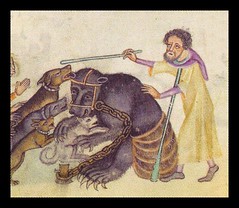
So! you're characters are riding through the countryside, or they come out of their doorways - and.... what do they see? Good stories, where ever they're set need worlds that are believable and often it's the variety and authenticity of the little details that really lift historical fiction, and give the reader the illusion that they've immersed themselves in a real world in all its facets: with farmers, clerics, travellers, pilgrims, knights or huscarls all mingling in a way that feels real. Of course no one has been to the Middle Ages, so how do you bring this level of detail to your story? The written sources tend to be a little bland on these little everyday details for almost any period because chroniclers don't see much noteworthy in the 'everyday.' There are a few places where you can find these details. Aelfric's Colloquys are a good example. Fancy catching a whale today lads?! Check out Ann E. Watkin's translation here But luckily the monks who illustrated thier texts seem to have had a penchant for putting the everyday in the margins of the holy, profound, sacred and heroic texts they were illustrating.

Wednesday, May 9, 2012

Have you liked Shieldwall yet?

http://www.amazon.co.uk/Shieldwall-Justin-Hill/dp/0349123373/ref=tmm_pap_title_0?ie=UTF8&qid=1315579893&sr=1-2

Tuesday, May 1, 2012

How to write a Medieval Novel: a practical guide no. 1

The Dark Ages?! Not at all. As I'm doing all this again, I thought I would list the things I've found useful in creating a convincing medieval setting.
1. The literature. Duh! In some ways there's nothing better than what contemporaries wrote about the world they lived in. For an Anglo Saxon setting this left me a little stumped, as anyone who's read any Anglo Saxon poetry, knows that the Anglo Saxons lived in a permanent winter, amidst ruins, and lamenting the fate that led them to exile/lordlessness etc. I was left a little stumped, because I couldn't have a novel set in a permanent midwinter. But then I came across this book, The Lost Literature of Medieval England, in the corner of Lingnan University library, which had last been taken out in 1962. A fabulous read, it also introduced me to the corpus of Anglo Saxon literature written in Latin, which composes of hagiographies, which are the opposite of the poetry, in that they chronicle how saints turned cold wilderness into flowering fields full of birds and bounty. Bingo! I now had contemporary sources chronicling both their of summer and winter. But of course it's not so straightforward, as writers often wrote because they had ulterior motives. Richard Fletcher is very good in The Barbarian Conversions, in teasing the religious accounts of conversions, where Saint A turned up at pagan site Z, chopped down their sacred oak, and then the people were amazed and accepted Christ. He asks the kind of questions any serious writer should ask: what exactly did that mean? How well did people understand what they were accepting. How much did older beliefs survive and continue in different forms. I find it's always good to remember that just because people lived in a less enlightened age, they were not necessarily any more or less daft than people now. And in many ways their concerns might prove surprisingly similar to worries now. Take the Anglo Saxon charms, for example. Often they say put a poultice on and say a certain prayer or charm three times. Now the simple reading would be that they believed in the power of mystical charms. Or - and perhaps a more practical and interesting explanation is that the repeating the charm five times took a certain and appropriate amount of time. Something of an ancient egg charmer.